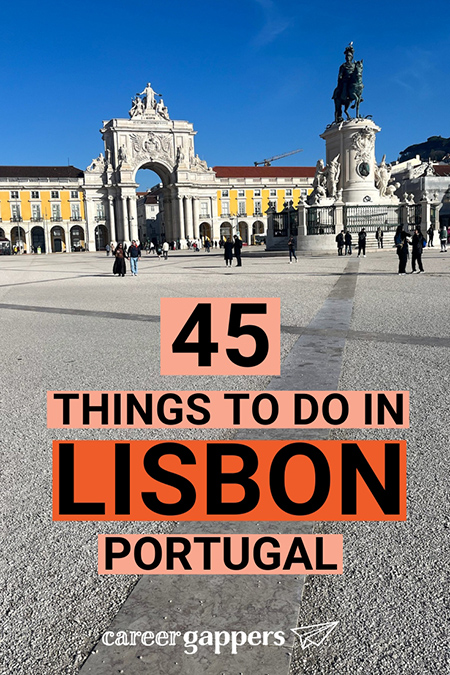
Lisbon is a city that is guaranteed to charm you. Spread across seven epic hills, there is a sweeping landscape around almost every corner, a blanket of red rooftops stretching out to the banks of the River Tagus. You’ll never want for things to do in Lisbon, a place where old trams trundle along steep cobblestone alleyways, majestic white basilicas tower over leafy green parks, and paths cross at busy food markets.
At night the city awakens with restaurants spilling onto the streets and fado clubs welcoming you with open arms. Not sure where to start exploring? Here are the best things to do in Lisbon for a fulfilling stay.
This site contains links to travel services we love, from which we may make commission at no extra cost to you.
Activities to book before your Lisbon trip
Want to start planning straight away? Here are some of our favourite things to do in Lisbon that are best booked in advance
🍷🥪 Lisbon food and wine tour: the tastiest way to discover the city!
🪕🎼 Fado show and dinner: a night of Lisbon’s historic storytelling music tradition
🏰🚞 Sintra, Cascais and Cabo da Roca: a wonderfully packed day trip from Lisbon
🦚🏰 São Jorge Castle: skip-the-line entry with a guided tour to this iconic landmark
Lisbon logistics — plan ahead:
💳🇵🇹 Lisbon Card: public transport access, free entry and discounts for attractions
📱📶 Airalo eSIM: very good value packages for mobile data in Portugal
🚌🎫 Busbud: we always use this site to find and book buses in Portugal
Exploring the city with the Lisbon card
Lisbon has a wealth of attractions to explore, many of which require entry fees. If you are planning to spend 1, 2 or 3 days in Lisbon, then you can save a lot of money and hassle by buying a Lisbon Card.
The card gives you free entry to over 50 attractions across the city, including many museums and historic buildings. It includes several of the highlights we feature in this article, such as Jerónimos Monastery, the Pilar 7 Bridge Experience and the Santa Justa Lift. It’s possible to make your money back on the card by visiting just two of the attractions it includes!
Better still, the card also gives you free access to public transport. Unlimited use of trams, buses will save your tired legs on all those steep hills. You can buy the card for 24, 48 or 72 hours, making it great value for a short trip.
If you want to know more about prices for attractions, transport and other typical trip expenditure in the city, check out this guide: how much does a trip to Lisbon cost?
Where to stay in Lisbon for a short break
I spent four days and three nights on a workation in Lisbon, enjoying the sights of the city while working remotely. My Story Hotels provided me with a complementary stay at three of their five beautiful hotels in the city, each with a different character and charm.
Our full review of My Story Hotels in Lisbon goes into depth on each experience, and why it’s a great place to stay in Lisbon.
After several more returns to the city, we also compiled a comprehensive guide to Lisbon’s neighbourhoods for first-time visitors.

Here’s a quick snapshot to help you choose which My Story Hotel will be right for you in Lisbon:
- My Story Hotel Figueira: fabulous central location and featuring an excellent restaurant, bar and café, La Squadra
- My Story Hotel Tejo: set in a restored 18th-century Pombaline building at the heart of the city, a few minutes’ walk from the Alfama
- My Story Hotel Rossio: many rooms have a glorious view over Rossio Square, and it has a beautiful breakfast room – great for couples!
Another option is to pick out one of the hundreds of self-catered apartments across the city. Get started with our recommendations on the best Vrbo Lisbon apartments.
For something extra special, check out our list of hotels in Lisbon with a rooftop pool.
Things to do in Lisbon: discovery tours
1. Explore local flavours on a Lisbon food and wine tour

A walking tour is the perfect way to introduce yourself a new city, and even better if it involves food! We had the BEST time on this Lisbon food and wine small group tour, which includes no less than 15 tastings of local delicacies and tipples.
It’s the kind of tour that takes you to those little back-street foodie spots that have been in the same families for generations, but nobody knows about except the locals.
It lasts around three hours, and truth be told, there is a lot more eating involved than walking! You will try classics like bifana (pork sandwich), pastéis de bacalhau (salted cod fritters), home-cooked fish stew and various charcuterie, all paired with local beers, wines and spirits.
Check out our review of the Lisbon wine and food tour for a full run-down of the tastings you can expect.
2. Take a free walking tour (Lisbon free chillout tour)

Free walking tours are a great way to get to know a city when you first arrive. We always like to take them on our travels.
In Portugal’s capital, Lisbon Chill Out provides one of the longest-running walking tours in Europe. It runs daily throughout the year, exploring a mixture of Lisbon’s highlights and hidden gems. Bring some spare change, as you’ll no doubt want to leave a tip!
3. Explore Lisbon’s hills on an e-bike tour

If traipsing up and down Lisbon’s hills sounds like too much effort, another option is to explore the city on a Lisbon hills electric bike tour.
The tour enables you to cruise through the highlights of the neighbourhoods of Alfama, Mouraria and Graça, with minimal effort, on eco-friendly e-bikes.
It includes some of those fabulous miradouros we mentioned earlier, as well as various quirky shops and local eateries along the way.
4. Yellow bus tours

Walking around Lisbon, you will often encounter the sight of bright yellow open-top buses navigating the popular districts. These yellow bus tours run on a hop-on, hop-off basis, which is great for exploring the city at your own pace.
A 48-hour yellow bus tour ticket works out at particularly good value, as it covers two different routes. It also gives you access to the public transport system for the duration of the ticket, including the Santa Justa Lift, and discounts at some restaurants.
The two routes covered are Modern Lisbon and Belém, which together encompass a huge number of the top attractions around the city.
So, if you are spending a weekend in Lisbon, the yellow bus tour is a fun and convenient option for finding your way around.
5. Ride the iconic number 28 tram

We’ve mentioned trams in Lisbon throughout this article, but one particular route deserves a special mention. The city’s yellow trams have been trundling around the streets for over 80 years, and the number 28 service has become somewhat of an icon.
The 28 route connects many of the city’s most popular tourist areas, including Baixa, Graça and the Alfama, as well as the more chilled-out, trendy local neighbourhoods of Estrela and Campo de Ourique. It runs from early morning until late at night, and will save you walking up many of the city’s hills.
Riding the 28 tram almost feels like taking a step back in time. Many of the services are fitted with the original wooden interiors and brass dials.
It’s a popular service, so it can get crammed on board! Take a ride early or late in the day to avoid the crowds, and always be vigilant for pickpockets.
With a Lisbon Card, you can explore the city by riding the tram until your heart’s content, and enjoy free access to many of the sights you can stop at along the journey.
Things to do in Lisbon: sightseeing and architecture
6. Explore the Alfama (the old town)

In many ways the Alfama neighbourhood is the heart and soul of the city, and a must to include in your Lisbon itinerary. Spread across a lofty hill that climbs from the Tagus River up to the turrets of São Jorge Castle, it is the oldest part of the city, and home to many of its cultural icons.
The Alfama is also one of the prettiest parts of Lisbon. It comprises a tangle of traditional townhouses in an array of colours, navigated by a maze of steep and winding cobbled roads.
In the daytime it is a whirr of activity. Wander its streets at night and you will encounter artisan shops and fashionable cafés with their doors still open, and people gathering to see views over the rooftops in moonlight.
This neighbourhood has been a part of Lisbon’s story for centuries, dating back even before the devastating earthquake of 1755. But, whereas it was once the city’s most deprived area, in modern times it has becoming a thriving, vibrant place that is still very much in touch with its roots.
A lazy morning or afternoon stroll in the Alfama is one of the best things to do in Lisbon when you first arrive, and you want to get to know the city. For a real local insight, you can take a guided walking tour of the Alfama.
7. Walk on the walls of São Jorge Castle

Standing on top of one of Lisbon’s highest hills, São Jorge Castle is the city’s most conspicuous landmark. You can see it from many miles around in all directions.
It is also one of Lisbon’s oldest structures and has played an integral role in the city’s history since its beginnings. A protective fort has existed on the hill for over 2000 years, and the current structure was built in the 11th century.
For an entry fee of €17 – or a skip-the-line ticket plus a guided introduction for a little extra – you can enter the castle’s grounds and explore freely. Before venturing inside the walls, it’s nice to enjoy a meander around the gardens, stopping to appreciate the sweeping views over the city from the edge.
Look out for the peacocks, too! I hadn’t heard about them before visiting, so I wondered for a moment what the strange shrieking noise was in the courtyard area. The peacocks at the castle are huge, colourful and fascinating to watch. Hang around a while and you might see feeding time.
Best of all, though, is the chance to walk around the top of the castle walls. Explore inside the turrets and between the ramparts, where knights of old once walked, looking out on an unobstructed city panorama.
8. Explore inside Sé, Lisbon’s historic cathedral

Lisbon Cathedral, also known simply as the Sé, is another historic icon of the city nestled in the Alfama neighbourhood. It is Lisbon’s oldest church, having stood for nearly 900 years.
Like many buildings of its age, Lisbon Cathedral has been restored and reimagined over the years. Most notably it was rebuilt after being devastated in the 1755 earthquake.
The two stone clock towers rise over the skyline of the Alfama, and in between them the magnificent rose window looks out over the city.
Entry to the cathedral is €7 for adults and €5 for children 7-12, while there is no fee for those under 7, and you can visit all areas open to the public throughout the day, monday- Saturday until evening mass is held at 6pm, November to March, and until 7pm, April to October.
Tip: take a walk around the Alfama at night and you will see the cathedral looming above you in soft, eerie lighting.
9. See the magnificent Jerónimos Monastery

Jerónimos Monastery is without doubt one of the most stunning pieces of architecture in Lisbon, and a foremost example of the Portuguese Manueline style.
Located in the Belém district, which is about 8 kilometres west of downtown along the riverfront, the building was commissioned by King Manuel I in 1501 and was the residence of the monks of the Order of Saint Jerome for many years.
It no longer serves as a monastery, but remains a site of great religious importance. The complex contains the Church of Santa Maria, which is unique in its sculpted column design.
While it is free to visit the Santa Maria Church, a ticket to visit the monastery is €19, which includes access to all areas that are open to the public(or it’s free with the Lisbon Card and you can skip the queue).
Tram line 15 passes right in front of the monastery. If you catch it on a clear day, visit in the morning to see the sunshine bouncing dazzlingly off the front of the building. It’s quite the impressive sight as you arrive! You can also reach it via various bus lines, including the 28, 714, 727, 729 and 751.
Check out this excellent guide to visiting Jerónimos Monastery for more in-depth information.
10. Visit the historic defensive fort of Belém Tower

The story of Belém Tower is closely tied to that of Jerónimos Monastery, and the two buildings were together designated as UNESCO World Heritage Sites in 1983.
Belém Tower was also built by King Manuel I, who saw the need for a defensive structure on the River Tagus estuary. The 30-metre-high white limestone tower then stood guard as Lisbon dominated world trade activity throughout the 15th and 16th centuries.
Entry to the tower is €15 (or free with the Lisbon Card). Inside you can see magnificent jewelled windows fitted with cannons, lower pits where prisoners were once flung, and decorated halls and chapels over its five floors, connected by a spiral staircase.
The site is located just a little further along the 15 tram line and bus routes from Jerónimos Monastery (it’s about a 15-minute walk between the two buildings).
11. Check out the museums in the Belém area

While you are in the Belém area seeing Jerónimos Monastery and Belém Tower, you also have the chance to check out several of the best museums in Lisbon. The neighbourhood has the highest concentration of museums in the city, and many of them are free to enter with the Lisbon Card.
These are some of the top museums you can try in and around Belém:
- Museum of Contemporary Art – MAC/CCB: Lisbon’s contemporary art and architecture museum
- Museu de Marinha: a navy and maritime museum located in the western wing of Jerónimos Monastery
- Museu da Presidência da República: the official residence of Portugal’s president, housed inside Belém Palace
- Planetário de Marinha: screens educational shows about the solar system in several languages
12. Climb 114 steps into the dome of Estrela Basilica

The white dome of the neoclassic Estrela Basilica flanked by two awesome bell towers is a standout landmark of the Estrela neighbourhood. Indeed it is one of the most beautiful buildings in Lisbon. I caught sight of it approaching downhill from the Campo de Ourique neighbourhood, and had to stop by to take a closer look.
You can enter and explore the basilica’s dazzling interior of pink and black marble. Queen Maria I was laid to rest here after she died in 1816, and her tomb is one of the most ornate features.
The white rococo domed roof is also accessible to visit. You need to climb 114 steps to reach it, but it’s worth the effort for the amazing views, spanning from the 25 de April Bridge around to São Jorge Castle.
The 25 and 28 trams both stop at the basilica, or you can take the 709 bus instead. On the metro, you can get off at Rato, which is a ten-minute walk away.
13. Catch the changing of the guards at São Bento Palace

As Portugal’s capital city, Lisbon is the home of the country’s parliament, which meets at São Bento Palace. The 16th-century building was actually once a monastery, but became the seat of parliament in 1834.
The palace’s entrance is a splendid white facade of columns and statues, guarded by soldiers, as is usually the case where high-ranking politicians meet. When walking past one mid-afternoon I was fortunate to see the ritualistic moment of the guard change.
You shouldn’t have to hang around too long to see it yourself. The guards stand in front of the palace from 9am to 7pm every day, and change once every hour.
If you don’t manage to catch the guard change, it’s still a nice building to wander past, and there’s a nice view facing onto the Príncipe Real and Bairro Alto neighbourhoods from the platform in front of the entrance.
14. See the ruins of Carmo Convent

Nearly three centuries on, some of the remnants of the 1755 earthquake can still be seen in Lisbon today. The most striking example is the ruins of Carmo Convent.
This was Lisbon’s largest and most important church before the city was hit by the earthquake. Its roof collapsed in the disaster, tragically at a moment when people were inside the building attending mass.
Despite the carnage, much of the structure remained intact. The original arches still stand eerily tall today, interspersed with the remnants of old stone, like flesh clinging to a skeleton, with sunlight pouring in from above. It is a lasting monument to the tragedy that claimed more than 50,000 lives in the city.
Entrance to the grounds costs €7, or €5.60 if you have a Lisbon Card. This includes access to an archeological museum that is contained within the complex.
15. Ascend to the top of Arco da Rua Augusta

The triumphal arch of Arco da Rua Augusta is symbolic of the city’s recovery from the 1755 earthquake. It was constructed in the aftermath and completed in the 19th century, standing as an icon of the city’s rebirth.
A large plaza, Praça do Comércio, separates the face of the arch from the shore of the River Tagus. In the morning you get a great view of it from this side in the full glare of the rising sun.
On its far side, the arch overlooks the streets of downtown Lisbon. You can capture this view by taking an elevator ride to the top, followed by a short staircase up to a viewing platform. It’s also a great vantage point for spotting the ruins of Carmo Convent.
Entry to Arco da Rua Augusta is €3, or free with a Lisbon Card.
16. See the symmetrical interior of the National Pantheon

The most conspicuous of the white-domed buildings rising above Lisbon’s red rooftops is the National Pantheon. Officially called Santa Engrácia Church, this 17th century structure is the final burial place for many of the country’s icons, including presidents, adventurers, poets, artists and fado stars.
The building took nearly 300 years to complete, with its dome only finished in 1966. It has even sparked a phrase in Portuguese that’s used when something takes a long time.
It has an unusual and innovative design, built on the shape of a Greek cross with four equal arms. The dome climbs 80 metres high, and underneath it lies a wonderful symmetric floor design, surrounded by pristine stonework and sculptures. An outdoor terrace in front of the dome looks out onto the river.
You can pay €5 to enter the National Pantheon, explore the interior and access the terrace, or it’s free with a Lisbon Card. To reach it you can take the 28 tram, which stops nearby. It is open 10am to 5pm, but note that the building is closed on Monday.
17. Ride to the top of the Santa Justa Lift

The lofty hills of Lisbon can be tough to navigate on foot. Thankfully, throughout the city you will find a network of old elevators and funiculars.
One of these, the Santa Justa Lift, is more than just a means of getting from one point to another. The late 19th-century iron structure has become an iconic feature of the city, and from its pinnacle you can see a gorgeous view over downtown Lisbon towards the Alfama and São Jorge Castle high on its hill.
It also looks pretty impressive from below. Make sure you check out the view upwards from Rua de Santa Justa!
It costs €5.30 to ride up the elevator or it’s free with a Lisbon Card. Alternatively, you can reach the top level by foot just a few paces away from Carmo Convent, or climb up the backstreets and stairways from Rua do Carmo below.
18. Take in the Pilar 7 Bridge Experience

Another iron structure in Lisbon that offers an eye-watering ride and an impressive view is the Ponte 25 de Abril Bridge, which was completed in 1966.
The bridge straddles the River Tagus between Lisbon and the Almada municipality on the north and south sides of the bank. Over two kilometres in length, it is one of Portugal’s greatest engineering feats.
On the north side of the bank, you can learn about the bridge’s construction and ride an elevator to the very top at the Pilar 7 Bridge Experience. Tickets available from €3, or it’s free with a Lisbon Card.
19. See Cristo Rei, Lisbon’s Christ statue

When you think about statues of Christ with arms spread wide, Rio de Janeiro’s Christ the Redeemer immediately springs to mind. Brazil’s icon and modern wonder of the world has inspired many other Christ monuments around the globe, including Lisbon’s Cristo Rei, ‘Christ the King’.
Cristo Rei is the tallest monument in Portugal and among the country’s tallest man-made structures of any kind. It stands in Almada the on the south side of the Tagus, visible from almost anywhere in Lisbon.
It’s hard to grasp the sheer scale of the statue when viewing from across the river in Lisbon, but it is huge. The plinth on which it stands is 80 metres tall, at which point there is a viewing platform, with the statue climbing up another 30 metres above. The view back across to Lisbon from the viewing platform is a staggering one.
To visit Cristo Rei, you need to travel across the river. The best way to do this is by ferry from Cais do Sodré to Cacilhas. The journey costs €1.55 each way, with ferries setting off every 15 minutes or so. The crossing takes about 10 minutes and offers some lovely views.
You can then take a short bus ride or walk to the statue. Bus 101 goes straight from the ferry terminal to the statue, and departs every half hour.
Things to do in Lisbon: parks and hangout places
20. Hang out a miradouro at sunset

Lisbon’s setting across seven hills means that the city is dotted with innumerable miradouros, or viewpoints. Many of these have been developed into public meeting spaces with parks, benches, telescopes, and sometimes some live entertainment too.
The Alfama and Graça adjoining neighbourhoods are particularly rife with miradouros. Located towards the east side of the city, this is where you will find the prime spots to watch the sun go down on the horizon.
Miradouro da Senhora do Monte is our favourite of all. Occupying the highest point in Lisbon, it offers an unrivalled west-facing vista stretching from São Jorge Castle out to the 25 de April Bridge in the distance. Crowds gather here at sunset to the atmospheric tunes of a local busking band.
The city’s sunsets are especially crisp if you visit Lisbon in winter, when the air is clearer and the clouds are thinner.
A little lower down in the Alfama, Miradouro das Portas do Sol offers a lovely alternative view across the neighbourhood’s rooftops and the landmarks of the National Pantheon and Monastery of São Vicente.
For more ideas, our guide to the best viewpoints in Lisbon picks out some of the top miradouros to visit for a range of city perspectives. Also take a look at our YouTube video about viewpoints in Lisbon for a quick summary of our recommendations:

21. See a beautiful sunrise at Alcântara Viewpoint

While the viewpoints around the Alfama and Graça are perfect for sunsets, the opposite is true of Miradouro de São Pedro de Alcântara in the Bairro Alto neighbourhood.
This viewpoint has a large observation platform where we saw one of the best sunrises we’ve ever seen in our lives. As the platform faces east, you can look out over the hills of the Alfama and the castle walls, while the sun slowly rises behind it, casting the whole scene in a beautiful red glow.
Make sure you check the Lisbon sunrise times and aim to arrive at least 20 minutes or so beforehand. The viewpoint is easy to reach either by public transport or a short walk from areas around downtown (for example it’s a 10-minute climb up from Rossio Square).
22. Take a stroll up Eduardo VII Park

Lisbon has many green spaces woven among its neighbourhoods. Eduardo VII Park is the largest in the city centre and the most visually impressive.
The 64-acre park is a long sloping lawn dissected by angular sculpted hedges and flanked by broad walkways. It climbs from Marquês de Pombal Square up to a grand pale monument commemorating the revolution of 25 April 1974.
From the observation deck at the top, there is a breathtaking view back down across the park towards the city and river below. When the sun is out, it’s a lovely place to get some fresh air and admire the surroundings
23. Find peacefulness in Calouste Gulbenkian Gardens

A few minutes’ walk away from the top end of Eduardo VII Park, Calouste Gulbenkian Gardens is one of Lisbon’s most tranquil spots, and a place where art meets wildlife.
These landscaped gardens incorporate a lake, walkways among trees and plants, and an open-air ampitheatre that hosts shows throughout spring and summer.
You can’t help but feel a sense of serenity as you walk among the surroundings. It’s also a place to discover Lisbon’s cultural footprint, with the grounds featuring an art foundation and Museu Calouste Gulbenkian (an art museum and library).
If you visit at midday, bring along a picnic or grab some lunch at the restaurant, which has outdoor seating looking out onto the lake.
24. Have a romantic walk in Estrela Gardens

The Estrela district is one of the loveliest parts of Lisbon. It’s a relaxed place of leafy gardens, coffee houses and hangout places, and is less infested with tourists than other parts of the city.
Estrela Gardens, spread out opposite the neighbourhood’s centrepiece, Estrela Basilica, is like an inner-city oasis. Dating back to the 1850s, the 4.5-hectare park is a place where you can relax or wander among the vegetation.
Following the winding pathways you will encounter a sculpted lake, duck ponds, a laidback café, and a proper old-fashioned wrought-iron bandstand, all intertwined with exotic plants and trees. It’s the ideal place to come on a hot day when you need to find some shade.
Visit the park at weekends to find it a bit more lively with community gatherings and outdoor events. Craft fairs are often held, and in summer you will occasionally see live music staged on the bandstand.
25. Hang out on the riverfront

So much of Lisbon’s history is rooted in its riverside setting, and this is also a part of what makes the city so beautiful. Traders and tourists have arrived at the city port on the north bank of the Tagus for centuries, and the riverfront is dotted with docks, landmarks and promenades. From atop the hills, the expansive estuary is ever-present in the background.
Spending time on the riverfront is a reinvigorating way to enjoy the city’s slower pace of life. Praça do Comércio, the plaza in front of Arco da Rua Augusta, is a good place to start.
Opposite the plaza on the riverside is the historic pier of Cais das Colunas, where 18th-century marble steps lead down to two weathered old pillars. This is a serene spot to contemplate for a moment while gazing out across the water towards the 25 de April Bridge and Cristo Rei on the far bank.
Many of the city’s landmarks cling closely to the riverfront. Walking east from Praça do Comércio, you will see the Alfama rising up above, and the protruding dome of the National Pantheon. Heading westwards, you could stroll lazily all the way to Belém Tower. It’s a good seven kilometres, but the scenery will make it much less of a toil.
26. Check out the pop-up markets at Praça da Figueira
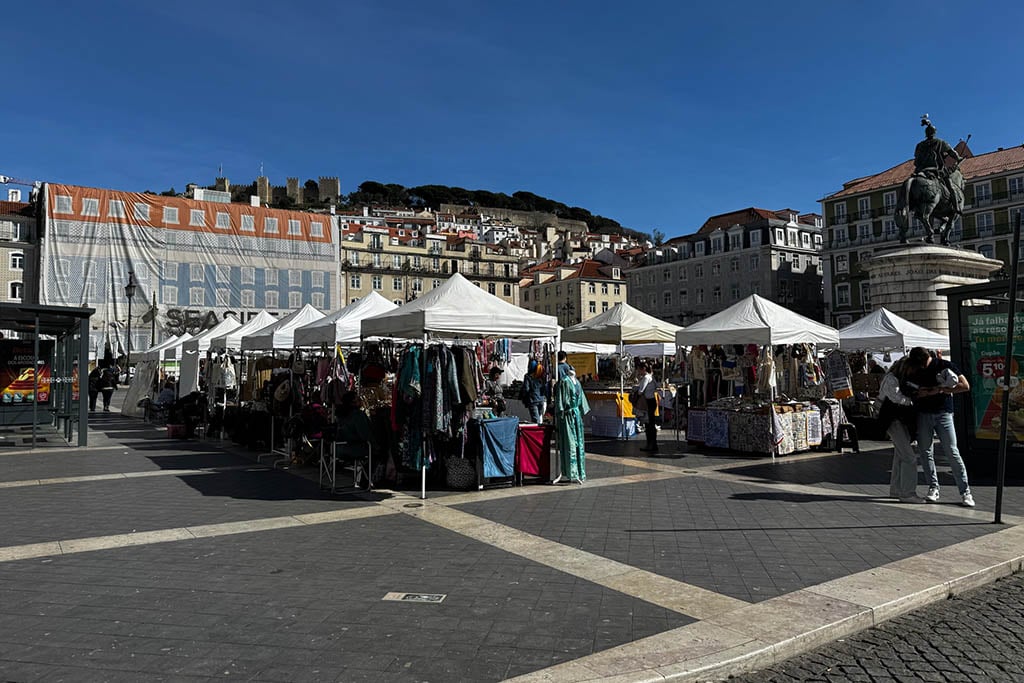
You will find plenty of little street markets around Lisbon, but one of the oldest often pops up on the cobbled square of Praça da Figueira.
In fact, this was the city’s original main marketplace. Traders used to gather here under a huge market hall from the 1880s until the structure was demolished in 1949.
These days there is still plenty of market activity in the open space left behind, and you will often find pop-up stalls selling clothes, craft and jewellery.
If you need a break and a nibble between browsing, you’ll also find Lisbon’s oldest patisserie, Confeitaria Nacional, on the corner of the square. This place has been going for nearly two centuries, and makes a charming stop-off for coffee and a baked treat.
Things to do in Lisbon: art and culture
27. Experience a night at a fado house

The story of Lisbon over the last 200 years cannot be told without fado music. The genre was born in the city, and has become a huge part of its identity.
Fado is in essence a simple form of music, with a vocalist accompanied by a guitarra player and sometimes a viola and bass viola too. The vocal style is hauntingly melodic, with lyrics that tell stories tinged with hope and optimism, contrasting the melancholy tone.
It is traditionally a communal music, performed in local pubs and cafés. ‘Fado houses’ are now a part of the city’s fabric. You will find them sprinkled among the Bairro Alto and Alfama neighbourhoods in particular, which were hubs of working class communities in the 19th century when the genre was burgeoning.
At a fado house today you traditionally enjoy a sit-down meal, with each course interluded by a short performance. The food is usually quite expensive to cover the cost of the show.
I went along to fado show and dinner at one of the foremost establishments for the genre today, where many of the greatest legends of modern fado have performed.
The intimacy of the experience is really quite wonderful, and it’s something you should try at least once if you get a chance while you’re in Lisbon. I was so captivated that I bought a vinyl of the legendary fadista Amália Rodrigues to recreate those memories back at home.
28. Go on a historical journey at the Fado Museum

If you want to really get under the skin of the history of fado, then a visit to the Fado Museum is an absolute must. You will be taken back on a journey through the history of fado music and the integral role it has played in Lisbon life over the last two centuries.
Entry to the museum is €5, which is excellent value for the experience. It includes an audio guide which adds context as you walk through the various displays.
Between cabinets of artefact and newspaper clippings, you will pass walls showing images of fado legends of the past. Next to each is a little number, and when you key it into your audio guide, it plays a clip of their music. It’s a really lovely touch that brings the genre to life and transports you back through the sounds of its icons over the decades.
Allow a couple of hours to explore the museum in its entirety. In addition to the permanent exhibition, there is also a temporary space on the lower floor.
The Fado Museum is in the Alfama district, and you can reach it by taking the number 728 bus. Note that it is closed on Mondays.
Keen to explore more about fado? Another cool option is to take a three-hour fado music walking tour, exploring the neighbourhoods where the genre originated, and rounded off with a typical meal at a fado house.
29. Discover the city’s street art

The more I explored Lisbon, the more similarities I noticed with the colourful Chilean city of Valparaíso. Both are port cities that once flourished in maritime trade. Both are built over several hills, each with its own distinctive neighbourood.
But perhaps the most striking similarity is with the street art scene of Valparaíso. The street art movement played a revolutionary role in Lisbon as it transitioned from a dictatorship to a democracy in the 1970s.
Street art remains an important part of the Lisbon’s cultural identity today. Around the city, you will encounter huge, colourful murals, sometimes in the unlikeliest of places.
The picture above shows Desassossego by local artist Pedro Campiche, also known as Akacorleone, which I stumbled across walking around the corner of the quiet Rua Damasceno Monteiro in the Graça neighbourhood.
Some notable murals to look out for in Lisbon include:
- A homage to the 1974 revolution on Rua Natália Correia by Shepard Fairey, the American artist behind the famous Barack Obama ‘hope’ poster
- A giant portrait of a Brazilian chief on Rua Alberto José Pessoa in the Marvila district by São Paulo artist Eduardo Kobra
- A colourful mural of Poseidon on Rua de Santa Apolonia by Spanish street art duo Pichiavo
30. Catch a contemporary art exhibition at MAAT

Lisbon is a brilliant city for art lovers, and one of our favourite spots for browsing is the Museum of Art, Architecture and Technology (MAAT). This fantastic, modern space sits on the riverfront close to many of the other great museums in the Belém neighbourhood.
There is a rotating schedule of varied exhibitions at the museum (which feels more like a gallery). On one of our trips to the city we headed here to see a Vivian Suter display after Lisa had read about it. The curation was absolutely top-class.
On the same visit, in one of the museum’s smaller galleries, we saw a light exhibition called “Rooms” by Anthony McCall, with a series of laser configurations in a dark space. There’s always a good mixture of inspiration and interactivity here.
31. See a show at Teatro Nacional Dona Maria II

Teatro Nacional Dona Maria II, Portugal’s national theatre, is situated in Rossio Square in the heart of Lisbon. Facing imposingly onto a tree-lined plaza, it is has been a pinnacle of the country’s performing arts culture for nearly two centuries.
The theatre has been through its fair share of challenges over the years. In 1964 it was burned to the ground in a devastating fire, and it took another 14 years for it to be rebuilt.
If you happen to be around on a Monday, you can take a one-hour guided tour of the theatre that costs €10 and must be booked in advance.
Fancy seeing a show? There’s a regular programme of performance at the theatre. Check out its website to see what’s on.
32. See the iconic Casa dos Bicos

The 500-year-old Casa Dos Bicos, also know as the ‘house of spikes’, is one of Lisbon’s most curious buildings. Its bright facade is riddled with over a thousand miniature diamond shapes jutting out.
Miraculously, the building stood firm through the 1755 earthquake, and so it is one of very few structures from its era that survives today. Also look out for the old olive tree standing in front of it, under which the ashes of José Saramago, a Portuguese Nobel literature prize winner, are buried.
Originally built as a palace, it now serves as a museum, literary event space and home to the José Saramago Foundation. Inside you can explore the life and work of Saramago and a library of his literature.
33. Browse hundreds of artworks at Atelier Museu Júlio Pomar
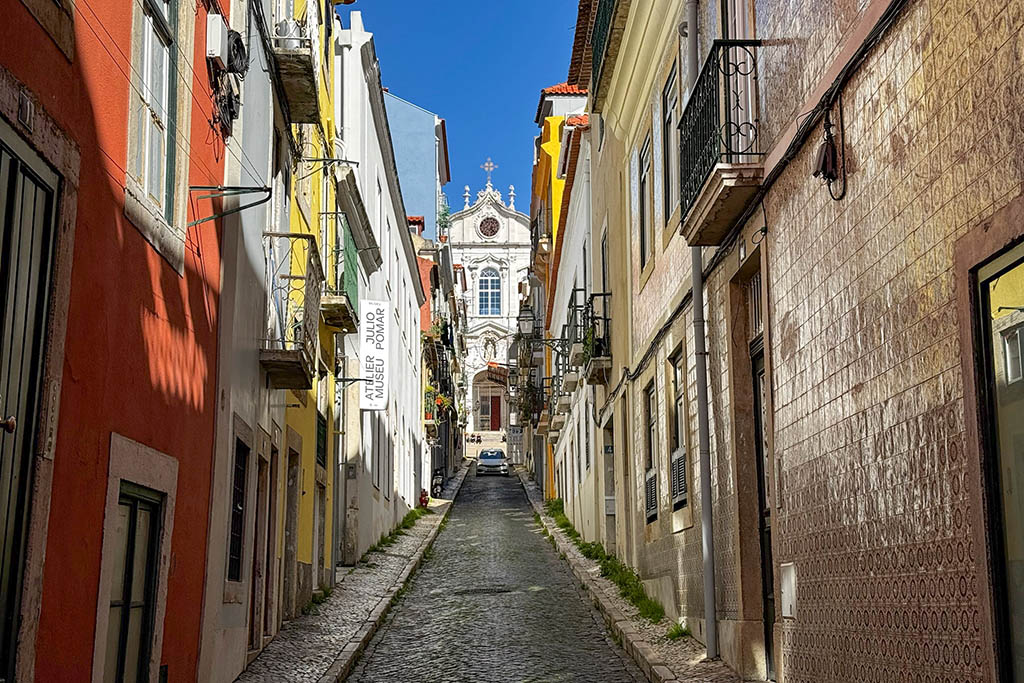
Tucked away on one of Lisbon’s colourful, cobbled sloping roads between Bairro Alto and Estrela, Atelier Museu Júlio Pomar hosts a collection of works by one of the city’s most prominent artists and historians.
This area of the city is beautiful to explore on foot, and the gallery makes for an engrossing stop-off. It features more than 1,500 of Júlio Pomar’s works, and others by his close friends and peers.
Set over two floors, the building itself is a work of art too, design by Pritzker Architecture Prize winner Álvaro Siza.
Things to do in Lisbon: food and drink
34. Explore the amazing local food markets

Lisbon’s plentiful food markets are great places to get immersed in the local food and drink scene. From trendy modern food halls to old-fashioned farmers’ style markets, each is different, but all are hubs of community life in the city.
Time Out Market is the city’s most famous food market and a popular tourist attraction. Set in the 19th century building of Mercado de Ribeira, central Lisbon’s oldest marketplace, it has been transformed into a gourmet food hall boasting an array of different national cuisines. The old market is still running within the complex too, opening for business at 6am each day.
Try taking this local market, food and culture walking tour that includes a guided visit to Time Out Market with insights into its history.
Mercado de Campo de Ourique is an off-the-beaten-path alternative to Time Out Market, set in a quieter neighbourhood. It also combines modern and historic market elements, but all integrated under one roof, and it’s less frequented by tourists. Try a plate of pica-pau from the Portuguese tapas stall – it’s incredible!
In the outer suburbs you will find more traditional-style markets, set in large halls and selling a range of fresh produce, typically opening early and closing shortly after lunch.
See our guide to the best food markets in Lisbon for a rundown of our favourite spots in the city.
35. Try Lisbon’s cuisine in a typical local restaurant

Food is a huge part of the local culture in Lisbon. With the city perched on the mouth of a river, it’s no surprise that fish is a big component of the local cuisine. There are also many international influences stemming from Portugal’s colonial past.
There’s nothing quite like eating in a proper local restaurant when it comes to trying Lisbon’s cuisine. In the neighbourhoods around downtown you will encounter many tourist traps that charge over the odds, but the best food is often found in the back-alley joints that are filled with locals.
Casa da Índia is one such place. Hidden in plain sight in the Chiado neighbourhood, this is a truly authentic local restaurant with a menu of simple but delicious dishes, at extremely reasonable prices.
For the best atmosphere, head here later in the evening at the weekend, when the bar stays open and the wine keeps flowing until the early hours.
And on our latest Lisbon jaunt, my friends who live in the city took us for lunch at O Soajeiro. This fabulous little family-run restaurant is a few minutes’ walk from Cais do Sodré station, but well away from the main drag.
The grilled fish and meats here beat anything we’ve found in the more popular restaurants, with much cheaper prices, and a relaxed, casual atmosphere. It’s places like these that really make the local food scene in Lisbon what it is.
36. Have amazing Mozambican food at Cantinho do Aziz
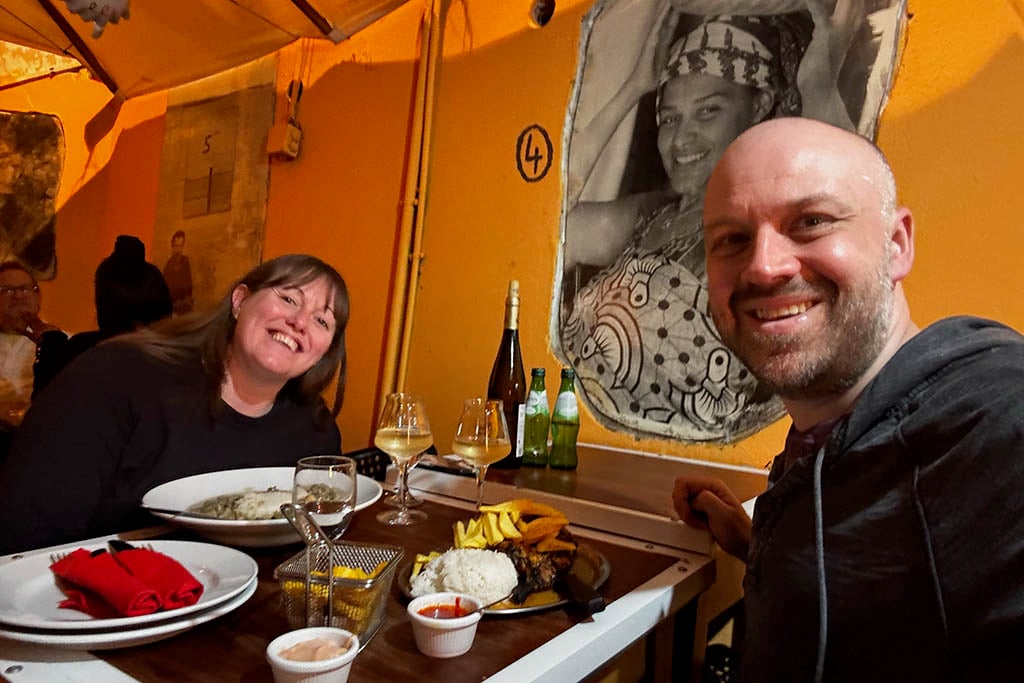
Portugal is closely associated with peri peri (or piripiri), but the dish actually originated in Mozambique when it was a Portuguese colony.
You’ll find some of the very best piripiri chicken anywhere in the world at Cantinho do Aziz, a fabulous little Mozambican restaurant tucked away on the sloped streets of the Moorish Quarter just below São Jorge Castle.
This is my personal favourite place to eat in Lisbon. The atmosphere is lively outside, with fires burning and African music playing, and the food is just superb.
On the last night of our latest Lisbon trip we tried the classic piripiri along with miamba wa macua, a house special dish combining prawns and plantain in a coconut and palm oil sauce. It’s not too pricy either, an all-round culinary gem.
37. Discover the city’s coffee culture

Lisbon is ready-made for coffee culture, with its laidback atmosphere and quirky, characterful neighbourhoods. Coffee was introduced to the city en masse during its colonial days, and in recent years the scene has burgeoned as the city has diversified with increased migration.
The cobbled, sloping streets of Lisbon are rife with independent coffee houses, many of which have their own roasters. The rise of remote culture and coworking spaces in Lisbon has only added fuel to the fire, and it’s now a common sight to walk past cafés filled with locals huddled over laptops. (Others have rejected the craze, displaying signs outside saying “no wifi, only coffee”).
Fábrica Coffee Roasters is one example of a great local coffee house, and it has now opened a handful of outlets around the city due to its growth in popularity. It makes a delicious cuppa roasted on-site, and provides a rustic setting of wooden furniture, exposed brick walls and industrial features.
Other excellent coffee shops to try include Hello Kristof, Copenhagen Coffee Lab and Simpli Coffee.
38. Try a classic pastry at the historic Pastéis de Belém

Pastry-based snacks are always on high demand in Lisbon, and none more so than pastéis de nata. You will encounter these Portugese egg custard tarts everywhere you turn, in cafés and bakeries all over the city.
If you want to try one of the very best pastéis de nata, then take a trip to one of Lisbon’s oldest bakeries: Pastéis de Belém, which has been running continuously since 1837.
Pastéis de Belém is located just a few paces away from Jerónimos Monastery, where the classic delicacy originated. In the 18th century, monks in the monastery used egg whites to starch nuns’ clothing, which left a surplus of yolks, which they repurposed into sweet custard tarts. Later, when times became tough, the monks began selling the tarts to sustain themselves.
Eventually, some monks set up shop at a sugar refinery nearby, and so Pastéis de Belém was born. It is believed to be the only bakery in the city that still uses the precise original recipe.
Pastéis de Belém also sells all sorts of other tasty baked snacks, sweet and savoury. It has a café, but another nice option when the sun in shining is to take your pastel de nata across the road to Praça do Império Garden, where you can enjoy it in full view of the monastery.
We’ve also been into Pastéis de Belém for breakfast. It opens at 8am daily, and there’s a huge seating area out the back, where you can also see the custard tarts being made when you walk in.
Check out these facts about pastéis de nata for more about their origins and history.
39. Buy some roast chestnuts from a street cart

If you visit Lisbon during the cooler months of the year, you will notice street vendors around the city selling bags of hot roast chestnuts. Their street carts are engulfed in a swirling smoke and a welcoming aroma that is guaranteed to intrigue you.
Before the days when exotic ingredients were brought back to Portugal from its colonies in South America and Africa, chestnuts were a foundation of the country’s cuisine, and the basis for many dishes.
Take a step back into these roots and warm your soul with a bag of toasty roast chestnuts. They typically cost €2.50 for a generously filled bag, and, like everything in this friendly city, they are always served with a smile.
40. Slurp some noodles at Buga Ramen


If you’re looking for a spicy Asian food fix in Lisbon, you must try the noodles at Buga Ramen, a Japanese chain that began in Spain but has spread into Portugal.
We were curious about this place as we noticed opposite We Love F Tourists (the hostel we were staying in). Feeling hungry on the first night of a trip, we decided to try it out, and we weren’t disappointed! There wasn’t any waiting for a table, even on a Saturday evening.
First of all, the place is a lot of fun. It’s full of bright lights and colourful displays that make you feel like you’re in downtown Tokyo, and our food was delivered to use by a cute little robot. The ramen is delicious, too! An all-round great choice for a laidback evening meal.
41. Try a 12-beer tasting slider at Crafty Corner

Lisbon is more known for its wine and ginjinha than beer, but the city actually has an excellent craft beer scene. We decided to investigate this (tough life isn’t it!) by spending a boozy evening at Crafty Corner, a great little bar in the Alfama.
The bar has roomy tables and a welcoming feel, and there are tons of local craft beers to try. If you can’t decide, then you can order a 12-beer tasting slider, with varying strengths, although most of them pack a punch!
After sampling this for ourselves and loving every sip, we highly recommend it. But also, you might want to take your time over it…
Things to do in Lisbon: day trips
42. Visit the seaside town of Cascais
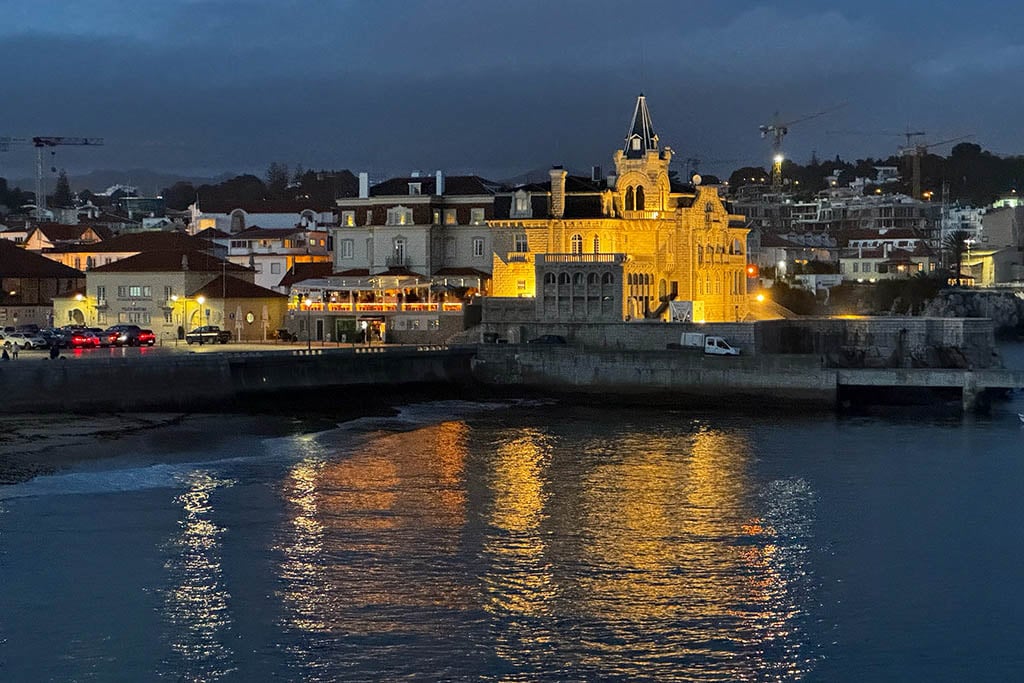
Just along the coast from Lisbon you’ll find some beautiful little seaside towns. Cascais is among the most popular to visit, and it only takes about 40 minutes by train from Lisbon, so it’s easily doable in a day trip.
Cascais has a cute but busy town centre with lots of shops, bars and restaurants within a short walk from the train station. Its seafront has a pretty harbour and beach, and a little further around you can explore some impressive historic buildings.
The Citadel of Cascais is a seafront fortification dating back to the early 15th century, its walls still standing high. And just inland, opposite the fort, art collections at Museu Condes de Castro Guimarães are housed in an elegant 19th century palace.
While you’re in Cascais you can also drop into Mercado da Vila, another in the Time Out Market collection, with a mixture of classic local grocery stalls and modern foodie spots.
43. Witness the incredible waves at Boca do Inferno

Boca do Inferno is a coastal phenomenon located a short walk outside Cascais, which I decided to feature separately as it’s a spectacle well worth highlighting.
When the Atlantic waves crash here onto the exposed rocky arches and formations, spray is sent tumulting high into the air with a thunderous sound, a dramatic natural scene that is impressive to witness.
We walked out to this spot just in time for sunset, when the experience is even more spectacular at golden hour. You can take a perch at a little outdoor bar called The The, order some cocktails and snacks, and enjoy the show.
44. Explore the magical mountain town of Sintra
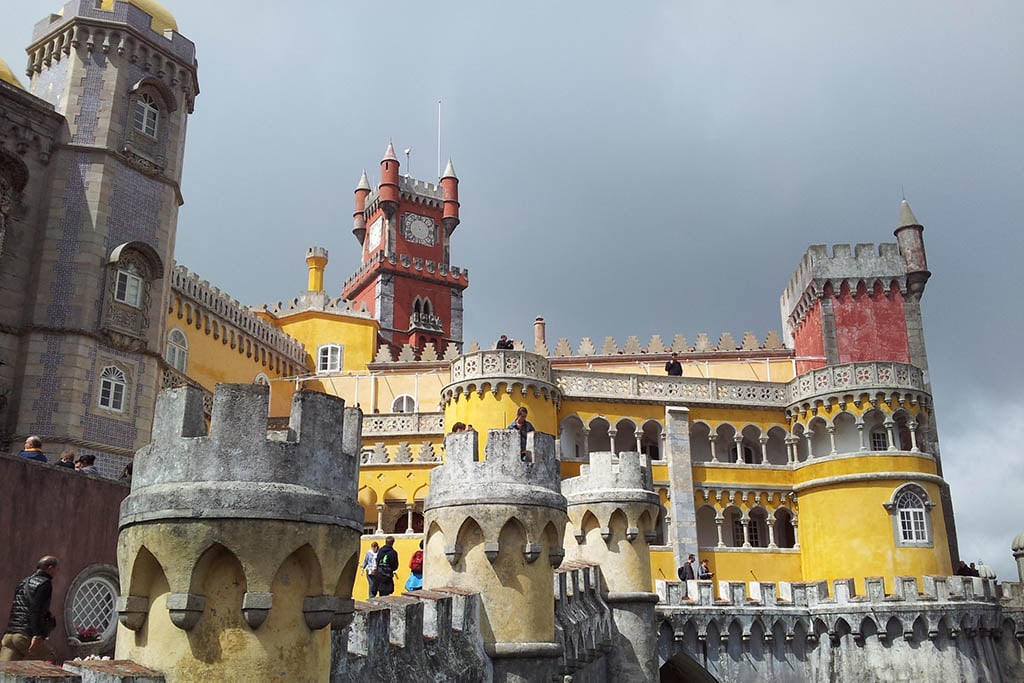
Sintra is one of Portugal’s most visited attractions, and it’s easily reachable from Lisbon, just 30 kilometres outside the city.
A colourful little town on the hilltop, with the red-and-yellow Pena Palace as its centrepiece, sits at the middle of a scenic national park. The town and its surroundings together form a UNESCO World Heritage Site.
You can reach Sintra by public transport using a combination of train and tourist bus, but you might prefer to take an organised tour. In a single day you can combine Sintra, Cascais and the Cabo da Roca Cliffs.
45. Hit the beaches and trails at Arrábida Natural Park

To the south of Lisbon lies one of the lesser-visited natural beauties within the city’s vicinity: Arrábida Natural Park. I spent a few days here on a work retreat, and wouldn’t mind going back for a few months!
The sprawling eco reserve features gorgeous barely-touched beaches along a mountainous peninsula, with green forests and fields inland intertwined with hiking trails.
I stayed at Casal do Frade on the team retreat, which is a fabulous little escape with rooms at very reasonable prices.
There are also some amazing seafood restaurants around this area. Make sure you eat at Hangar Meco, a restaurant in a hangar-shaped building with a stunning clifftop location, facing onto the sunset.
Best things to do in Lisbon, Portugal: map
You can see the locations of our recommended things to do in Lisbon by clicking on the map below:
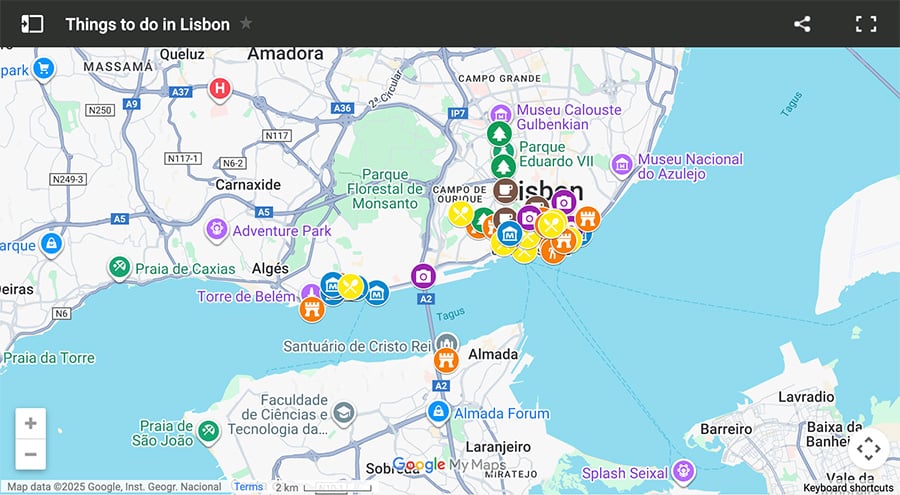
Have you spent time in Lisbon on your travels? Let us know about your experiences in the comments below.
Love this? Pin it for later!